https://dx.doi.org/10.24016/2026.v12.556
ORIGINAL ARTICLE
Internet Gaming Disorder and impulsivity in undergraduate students at a public university: psychometric evidence (IGD-20, BIS-15) and their association
1 Universidad Nacional Mayor de San Marcos, Lima, Peru.
* Correspondence: yannet.valencia@unmsm.edu.pe
Received: June 17, 2026 | Revised: June 27, 2026 | Accepted: August 04, 2026 | Published Online: September 19, 2026.
CITE IT AS:
Valencia-Chacón, Y. (2026). Internet Gaming Disorder and impulsivity in undergraduate students at a public university: psychometric evidence (IGD-20, BIS-15) and their association. Interacciones, 12, e556. https://doi.org/10.24016/2026.v12.556
ABSTRACT
Background: Internet Gaming Disorder (IGD) is one of the behavioral addictions of greatest clinical interest, and impulsivity has been identified as one of its main dispositional correlates. However, evidence in Latin American university populations and the psychometric properties of Spanish-language instruments remain scarce.
Objective: To determine the relationship between IGD and impulsivity, and to provide validity and reliability evidence for the IGD-20 and BIS-15 in university students from Metropolitan Lima.
Method: Instrumental and correlational cross-sectional study. A total of 225 undergraduate students participated (51% men; 49% women; M = 20.45; SD = 1.02) from one public university. The IGD-20 and BIS-15 were administered. Internal structure was examined through confirmatory factor analysis (CFA) with WLSMV estimation, reliability through internal consistency (Cronbach's alpha), and associations through Spearman's rho, Mann-Whitney U, Kruskal-Wallis, and effect sizes (Cohen's d, eta squared).
Results: The six-factor IGD-20 model showed good fit, (χ²(164) = 390.5, p < .001; CFI = .976; TLI = .972; RMSEA = .079; SRMR = .046); the three-factor BIS-15 model showed adequate fit after removing two items, (χ²(62) = 145.23, p < .001; CFI = .933; TLI = .916; RMSEA = .077; SRMR = .076). Reliability was acceptable (IGD-20: α = .61–.85; BIS-15: α = .70–.76). A positive, significant association was found between IGD and total impulsivity (rs = .34, p < .001), of small-to-moderate magnitude. Sex, gaming hours, and game-genre differences emerged for IGD, but not for impulsivity by sex.
Conclusions: The IGD-20 and BIS-15 show adequate psychometric evidence; impulsivity is positively associated with IGD, supporting its role as a dispositional vulnerability factor, with implications for prevention in university settings.
Keywords: Internet Gaming Disorder; impulsivity; university students; IGD-20; BIS-15; psychometrics.
The sustained growth of video game use, accelerated during and after the COVID-19 pandemic, has positioned Internet Gaming Disorder (IGD) as a phenomenon of increasing public-health relevance. IGD was included in the section of conditions requiring further study in the DSM-5 (American Psychiatric Association, 2013) and, subsequently, Gaming Disorder was recognized by the World Health Organization in the ICD-11 (World Health Organization, 2019). This pattern is characterized by persistent and uncontrolled video game use, salience, tolerance, withdrawal, conflict, and relapse, with associated functional impairment (American Psychiatric Association, 2013; Pontes et al., 2014).
In Peru, evidence on problematic gaming is still emerging and has mostly relied on video-game dependence measures such as the TDV, validated in Lima samples (Salas-Blas et al., 2017; Olivari-Moreno et al., 2024); this reflects a clear regional interest in exploring video-game addiction, while psychometrically robust IGD instruments remain scarce. Accordingly, the present study seeks to provide validity and reliability evidence for the IGD-20 and BIS-15 in a Peruvian (Latin American) university sample. IGD is included among the conditions requiring further study in the current revised edition, the DSM-5-TR (American Psychiatric Association, 2022), which is cited here instead of the 2013 version.
University students constitute a group of particular vulnerability, owing to time availability, technological access, and the self-regulation demands inherent to the transition to adulthood (Gisbert-Pérez et al., 2025); indeed, recent meta-analyses estimate that IGD prevalence is higher in young adults (6.1%) than in the general population, reaching 8.1% in samples composed solely of gamers (Gisbert-Pérez et al., 2025). Within this framework, impulsivity—understood as the tendency to act precipitously, without planning, and with inhibition difficulties—has been consistently proposed as a dispositional risk factor for behavioral addictions (Müller et al., 2023; Nuske et al., 2025). The Deficient Inhibition Model and the tripartite neurocognitive model of IGD (Brand et al., 2019; Dong & Potenza, 2014) posit that reduced inhibitory control fosters the persistence of gaming behavior despite its negative consequences. The review by Müller, Antons, and Brand (2023) further specifies that IGD is differentially associated with the facets of impulsivity—especially attentional and motor impulsivity in response to game-related cues—rather than with a unitary impulsive construct.
Assessing IGD and impulsivity requires instruments with adequate psychometric properties. The Internet Gaming Disorder Test (IGD-20; Pontes et al., 2014) operationalizes six dimensions (salience, mood modification, tolerance, withdrawal, conflict, and relapse), whereas the short form of the Barratt Impulsiveness Scale (BIS-15; Spinella, 2007) assesses attentional, motor, and non-planning impulsivity. Nevertheless, evidence on the functioning of these instruments in Spanish-speaking—and particularly Peruvian—populations is still limited.
The most recent meta-analytic evidence supports the relevance of this line of research. The meta-analysis by Nuske et al. (2025), which integrated 33 studies (N = 24,818) published in the ICD-11 era, reported a moderate and consistent pooled association between Gaming Disorder and trait impulsivity (r = .29; 95% CI [.24, .34]), with larger correlations when impulsivity was assessed using the Barratt Impulsiveness Scale (BIS) and in Asian samples compared with European and Western ones. In the Latin American context, the systematic review by Andrade et al. (2024) confirms this link, although it warns of methodological heterogeneity and the scarcity of psychometrically robust studies in the region. In parallel, the prevalence meta-analyses by Satapathy et al. (2025) in adolescents (8.6%) and by Zhou et al. (2024) on the effect of diagnostic criteria (DSM-5 vs. ICD-11) on IGD rates (6.7%) underscore the magnitude of the problem and the need for validated instruments and standardized criteria. The present study contributes to this debate by providing psychometric and correlational evidence from a context—the Peruvian university setting—scarcely represented in this literature.
Although the association between impulsivity and IGD has been documented internationally, relevant gaps persist: (a) scarcity of studies in Latin American university students; (b) insufficient psychometric evidence for the IGD-20 and BIS-15 in Spanish; and (c) the need to clarify the magnitude and patterns of the relationship according to variables such as sex, gaming hours, and game genre. The present study seeks to help fill these gaps in the Peruvian context.
Accordingly, the general objective was to determine the relationship between IGD and impulsivity in undergraduate students at a public university in Metropolitan Lima, while also providing evidence of internal-structure validity and reliability for the IGD-20 and BIS-15. It was hypothesized that a positive and significant relationship would exist between IGD and impulsivity, and that both instruments would display adequate factor structures and reliability levels in the studied sample.
It was further hypothesized that IGD levels would differ significantly according to sociodemographic and use variables, that is, that men, students with a higher weekly gaming load, and players of competitive genres would show higher IGD scores, whereas no meaningful sex differences were expected in impulsivity.
The study used an instrumental design to examine the psychometric properties of the instruments, along with a correlational, cross-sectional, and non-experimental design (Ato et al., 2013).
The sample consisted of 225 undergraduate students from a public university in Metropolitan Lima. The sample comprised 114 men (51%) and 111 women (49%), aged between 18 and 25 years (M = 20.45, SD = 1.02). Inclusion criteria were being enrolled in undergraduate studies, being aged 18 to 25 years, and reporting video game use. Incomplete questionnaires—defined as records from participants who exited the form before final submission—were excluded; because all items were set as “Required” in Google Forms, no partially answered items remained within submitted responses. A non-probabilistic convenience sampling method was used. The sample size (N = 225) is consistent with the recommendations for CFA using robust estimators for ordinal indicators (Flora & Curran, 2004; Kline, 2016), exceeding the criterion of 10 observations per item (Bentler & Chou, 1987; Nunnally, 1978) and representing an acceptable proportion for models with high factor loadings (MacCallum et al., 1999).
A total of 242 students accessed and started the online survey; 17 records were removed because participants exited the form before final submission, yielding the final analytic sample of 225.
Alongside the scales, a brief ad hoc questionnaire recorded the non-measure variables: age (in years), sex (man/woman), average weekly hours of gaming (grouped as under 10, 10 to 30, and over 30 hours per week), and preferred game genre, chosen from action/shooter (FPS/TPS), MOBA, role-playing (RPG/MMORPG), strategy, sports/racing, and casual/mobile games.
The 18-to-25-year age range was selected because it corresponds to emerging adulthood, a developmental stage marked by high technological access, autonomy in leisure time, and still-maturing self-regulation and inhibitory control, all of which heighten vulnerability to problematic gaming and make it a priority window for screening and prevention.
The Internet Gaming Disorder Test (IGD-20), originally developed by Pontes et al. (2014), was administered in its Spanish version. The Internet Gaming Disorder scale consists of 20 items answered using a five-point Likert scale, from 1 (“Strongly disagree”) to 5 (“Strongly agree”), which evaluates both online and offline video game activity carried out during the previous 12 months in terms of the diagnostic criteria for IGD (American Psychiatric Association, 2013). Items correspond to the components model of addiction established by Griffiths (2005).
This Spanish version corresponds to the validation carried out by Fuster, Carbonell, Pontes, and Griffiths (2016), who confirmed the six-factor structure of the IGD-20 in Spanish-speaking gamers; that study is the direct psychometric antecedent of the present work.
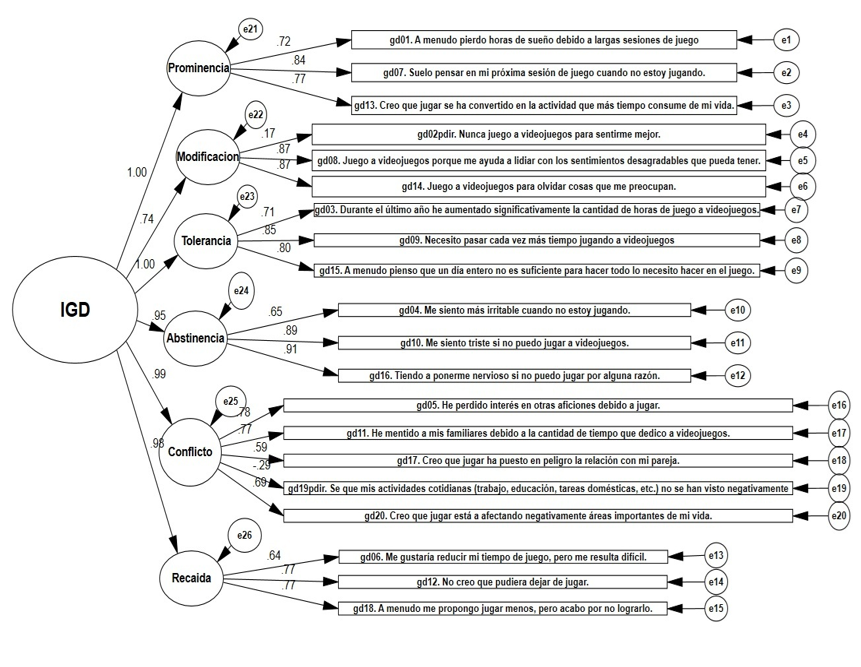
The scale is distributed across six dimensions. Salience (items 1, 7, 13) occurs when video game use takes precedence over all other activities in the person’s life; e.g., “I have often felt that my whole day revolves around gaming.” Mood Modification (items 2R, 8, 14) refers to the internal experiences of arousal or escapism while gaming; e.g., “I play games to forget about whatever is bothering me.” Tolerance (items 3, 9, 15) represents the increasing time needed to reach the desired mood state; e.g., “Over time I have needed to play more to feel satisfied.” Withdrawal Symptoms (items 4, 10, 16) are the unpleasant physical/emotional states when gaming is interrupted; e.g., “I feel irritable when I cannot play.” Conflict (items 5, 11, 17, 19R, 20) relates to interpersonal or intrapersonal conflicts and loss of control; e.g., “Gaming has caused problems with people close to me.” Relapse (items 6, 12, 18) is the tendency to revert to previous intense patterns after periods of control; e.g., “I have tried to cut down my gaming without success.” The original study reported a six-factor structure with acceptable indices and internal consistency between .61 and .85.
The short form of the Barratt Impulsiveness Scale (BIS-15), adapted by Spinella (2007), was used. It comprises 15 items on a four-point Likert scale (1 = rarely; 4 = always/almost always), organized into three dimensions: non-planning impulsivity, motor impulsivity, and attentional impulsivity. The short form correlated highly with the original BIS-11 developed by Barratt (1999) (r = .94) and preserved the three-factor structure. The instrument consists of 15 items distributed across three dimensions: motor impulsiveness (items 2, 9, 10, 12, and 13), characterized by acting without thinking; non-planning impulsiveness (items 1R, 5R, 7R, 8R, and 15R), characterized by the inability to anticipate the outcomes of decision-making; and attentional impulsiveness (items 3, 4R, 6, 11, and 14), defined as the tendency to make judgments or reach conclusions quickly.
The Spanish-language versions were reviewed against the Colombian Spanish adaptation of the BIS-15 (Orozco-Cabal et al., 2010) and the Spanish IGD-20, and their wording was verified through expert judgment and a pilot reading with Peruvian undergraduate students to ensure semantic and cultural equivalence for the Spanish spoken in Peru.
No lexical or grammatical modifications were required to adapt the Spanish wording to Peruvian Spanish; the pilot reading confirmed that all items were fully understood, so the original Spanish version was retained without translation changes.
The instruments were administered virtually using Google Forms between August 1 and October 15, 2023. The questionnaires were completed virtually via Google Forms. Participants were students from one public university in Lima, Peru, recruited through social media platforms. Informed consent was obtained online, with participants informed that participation was voluntary and anonymous, and without financial incentives, respecting the ethical principles of research involving human beings. It was also specified that the data would be used exclusively for academic purposes. Completion of the questionnaire required approximately 10 to 15 minutes.
An exploratory analysis was conducted to identify missing and outlier values. Univariate outliers were screened using standardized z-scores (|z| > 3.29) and box plots, and multivariate outliers were examined through Mahalanobis distance (p < .001); cases exceeding these criteria were reviewed prior to analysis. Internal-structure validity evidence was obtained through confirmatory factor analysis (CFA) on polychoric correlation matrices, using the robust WLSMV estimator (appropriate for ordinal indicators), with the lavaan (Rosseel, 2012) and semTools (Jorgensen et al., 2022) packages in R 4.2.1 (R Core Team, 2022), as well as IBM SPSS Amos 24 (Arbuckle, 2016). Fit was evaluated using CFI, TLI (≥ .90 = adequate fit), RMSEA (≤ .08), and SRMR (Hu & Bentler, 1999). Reliability was estimated through internal consistency with Cronbach’s alpha and McDonald’s Coefficient Omega (ω), given that alpha systematically underestimates reliability for ordinal indicator scales estimated with WLSMV. For inferential analysis, non-parametric tests were applied: Spearman’s rho (rs) for correlations, Mann-Whitney U for two groups, and Kruskal-Wallis H for more than two groups. Effect size was computed with Cohen’s d (0.20, 0.50, and 0.80 for small, moderate, and large effects) and with eta squared (η²: .010, .059, and .138). To interpret correlations, Cohen’s (1988) criterion was used: small (.10–.23), moderate (.24–.36), and strong (≥ .37).
In addition, to move beyond the descriptive nature of the bivariate analysis, a multiple linear regression model (ordinary least squares) was estimated on the original database (N = 225), in which the six IGD-20 dimensions acted as predictors of total impulsivity (BIS-15). Unstandardized (B) and standardized (β) coefficients, explained variance (R²), overall significance (F), and multicollinearity through the variance inflation factor (VIF) are reported.
This regression is reported only as an exploratory, complementary analysis and not as a study objective; because the high intercorrelations among the IGD-20 dimensions produce multicollinearity, the individual coefficients are interpreted with caution and no causal or predictive claim is made. Should a predictive model be required, a second-order/SEM approach would be more appropriate.
The research protocol was approved by the Institutional Research Ethics Committee of the Universidad Nacional Mayor de San Marcos (000227-2024-UPG-VDIP-FPSI/UNMSM). All participants were informed of the study's objectives and provided informed consent prior to participation. This study adhered to the ethical principles established by the American Psychological Association (2017). Before completing the survey, participants received an online informed consent form stating that participation was voluntary, responses were anonymous, no incentives were offered, and the data would be used exclusively for academic purposes.
The skewness (−.21 to 1.92) and kurtosis (−1.51 to 3.83) values of the items fell within acceptable ranges (Kline, 2016). The CFA of the original six correlated-factor model showed good fit: χ²(164) = 390.5, p < .001; CFI = .976; TLI =.972; RMSEA = .079; SRMR = .046 (Hu & Bentler, 1999). Factor loadings ranged from .74 to .96, with two exceptions: the reverse-worded items 02R (λ = .12) and 19R (λ = −.39), whose problematic behaviour coincides with that reported by Pontes et al. (2014). Inter-factor correlations ranged from .35 to .83. Internal-consistency reliability was adequate for most dimensions (Table 1; Figure 1).
Table 1. Internal-consistency reliability of the IGD-20 dimensions (N = 225).
|
Dimension (IGD-20) |
No. items |
Cronbach's α |
ω (Omega) |
|---|---|---|---|
|
Salience |
3 |
.82 |
.89 |
|
Mood modification |
3 |
.63 |
.74 |
|
Tolerance |
3 |
.82 |
.90 |
|
Withdrawal |
3 |
.85 |
.92 |
|
Conflict |
5 |
.61 |
.86 |
|
Relapse |
3 |
.77 |
.86 |
Note. Reliability estimated by internal consistency
Figure 1. Six-factor measurement model of the Internet Gaming Disorder Test (IGD-20).
The reverse-worded items 02R and 19R showed factor loadings below the recommended threshold, without substantially affecting the internal correlations of their respective dimensions (Mood modification and Conflict). This finding suggests a possible method effect associated with the reverse wording of these items, which is revisited in the discussion.
As the CFA is the study main analysis, its results are described narratively and not only in the table: most items showed strong standardized loadings (.74 to .96), whereas the reverse-worded items 02R (λ = .12) and 19R (λ = -.39) fell well below the .40 to .50 acceptability threshold, and the Mood modification (α = .63) and Conflict (α = .61) subscales showed the weakest internal consistency.
The skewness (.07 to .96) and kurtosis (−.98 to .03) values remained within acceptable ranges (Kline, 2016). The CFA of the three correlated-factor structure showed adequate fit after removing items 12 (motor impulsivity) and 4R (attentional impulsivity), which prevented a satisfactory fit: χ²(62) = 145.23, p < .001; CFI = .933; TLI = .916; RMSEA = .077; SRMR = .076 (Hu & Bentler, 1999). Factor loadings ranged from .45 to .84. The correlation between non-planning and motor impulsivity was very high (.98), whereas attentional impulsivity correlated moderately with both (.42 and .50). Reliability was acceptable: non-planning = .70, motor = .75, attentional = .71, and total scale = .76 (Table 2; Figure 2).
Table 2. Internal-consistency reliability of the BIS-15 dimensions (N = 225).
|
Dimension (BIS-15) |
Cronbach's α |
ω (Omega) |
|---|---|---|
|
Non-planning impulsivity |
.70 |
.75 |
|
Motor impulsivity |
.75 |
.82 |
|
Attentional impulsivity |
.71 |
.75 |
|
Total scale |
.76 |
.71 |
Note. Reliability estimated by internal consistency.
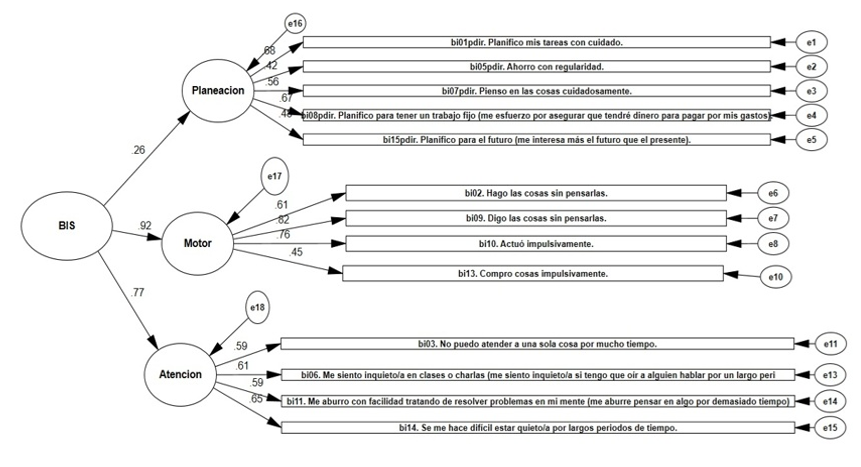
Figure 2. Three-factor measurement model of the Barratt Impulsiveness Scale short form (BIS-15).
A positive, direct, and statistically significant relationship was found between IGD and impulsivity. The correlation between the IGD-20 total score and the BIS-15 total was rs = .34 (p < .001) of moderate magnitude according to Cohen’s (1988) criterion. All IGD-20 dimensions correlated positively with the impulsivity dimensions, with coefficients between .11 and .35 (Table 3).
Table 3. Spearman's rho correlations between IGD-20 dimensions and impulsivity (N = 225).
|
IGD-20 |
Non-planning |
Motor |
Attentional |
BIS Total |
|---|---|---|---|---|
|
Salience |
.19** |
.22** |
.28*** |
.32*** |
|
Mood modification |
.21** |
.17** |
.20** |
.27*** |
|
Tolerance |
.11* |
.23*** |
.22*** |
.27*** |
|
Withdrawal |
.13* |
.23** |
.21** |
.27*** |
|
Conflict |
.18* |
.28*** |
.23*** |
.32*** |
|
Relapse |
.23** |
.20** |
.21** |
.30*** |
|
IGD Total |
.21** |
.26*** |
.27*** |
.34*** |
Note. * p < .05, ** p < .01, *** p < .001. Magnitudes interpreted according to Cohen’s (1988) criterion.
For the IGD-20, significant differences emerged by sex: men showed higher risk scores across all dimensions (d = 0.20 to 0.46, small to moderate effects). Likewise, students who played more than 30 hours per week and those who preferred certain game genres showed higher IGD levels. The game genres evaluated were action/shooter (FPS/TPS), multiplayer online battle arena (MOBA), role-playing games (RPG/MMORPG), strategy, sports/racing, and casual/mobile games; higher IGD scores were concentrated among players of competitive action/shooter and MOBA titles. In contrast, no statistically significant differences were found in impulsivity or its dimensions by sex (all p values > .05; d ≤ 0.07), as shown in Table 4.
Table 4. Differences in impulsivity by sex (N = 225).
|
BIS-15 (by sex) |
Women M(SD) |
Men M(SD) |
U |
p |
d |
|---|---|---|---|---|---|
|
Non-planning impulsivity |
9.11(4.48) |
8.51(4.32) |
5886 |
.364 |
0.07 |
|
Motor impulsivity |
6.61(4.87) |
7.26(4.97) |
5917 |
.398 |
0.06 |
|
Attentional impulsivity |
8.88(5.17) |
8.63(5.10) |
6254 |
.880 |
0.01 |
|
BIS Total |
8.20(3.38) |
8.14(3.61) |
6214 |
.817 |
0.02 |
Note. No significant differences were observed. U = Mann-Whitney U; d = Cohen’s d.
Table 4 presents the descriptive and non-parametric comparison statistics for impulsivity by sex. No statistically significant differences were observed across any BIS-15 dimension or in the total impulsivity score (all p > .05; Cohen’s d ≤ .07).
Finally, when comparing students at risk of IGD (n = 9), classified according to the DSM-5 criterion (≥5 of 9 endorsed criteria), showed significantly higher impulsivity (BIS-15 total; Mdn = 33.00) than students without risk (n = 216; Mdn = 27.00), Mann-Whitney U = 1480.00, z = 2.65, p = .008, r = .18 (small effect size). A non-parametric test was used given the non-normal distribution of scores and the marked imbalance in group sizes. This finding reinforces the association between IGD risk and impulsivity reported in Table 3.
The multiple regression model, estimated on the study’s original data (N = 225), was statistically significant, F(6, 218) = 5.92, p < .001, and explained 14.0% of the variance in impulsivity (R² = .140; adjusted R² = .116). As shown in Table 5, the only predictor with a statistically significant weight was the Conflict dimension (B = 0.152; β = .205; t = 2.25; p = .025), followed by Mood modification, which reached marginal significance (β = .150; p = .055). VIF values (1.53–4.96) remained below the critical threshold of 10; nevertheless, the high intercorrelations among IGD dimensions (moderate multicollinearity) explain why Tolerance and Withdrawal showed small, negative coefficients despite their positive bivariate correlations.
Table 5. Multiple linear regression of total impulsivity (BIS-15) on the IGD-20 dimensions, estimated with the original database (N = 225).
|
Predictor (IGD-20 dimension) |
B |
SE |
β |
t |
p |
|---|---|---|---|---|---|
|
Salience |
0.082 |
0.070 |
.156 |
1.18 |
.239 |
|
Mood modification |
0.073 |
0.038 |
.150 |
1.93 |
.055 |
|
Tolerance |
-0.050 |
0.079 |
-.088 |
-0.63 |
.532 |
|
Withdrawal |
-0.035 |
0.077 |
-.057 |
-0.45 |
.655 |
|
Conflict |
0.152 |
0.068 |
.205 |
2.25 |
.025 |
|
Relapse |
0.041 |
0.061 |
.076 |
0.68 |
.496 |
Note. R² = .140; adjusted R² = .116; F(6, 218) = 5.92, p < .001. B = unstandardized coefficient; β = standardized coefficient; SE = standard error.
The objective of this study was to determine the relationship between Internet Gaming Disorder and impulsivity and to provide psychometric evidence for the IGD-20 and BIS-15 in university students from Lima. The results confirm the hypotheses and allow a discussion on three levels: the main relationship, the psychometric properties, and the group differences.
The central finding, a positive, significant correlation between IGD and impulsivity (rs = .34), is fully convergent with international meta-analytic evidence. The observed magnitude is very close to the pooled association of r = .29 reported by Nuske et al. (2025) and is especially consistent with their finding that correlations tend to be larger when impulsivity is measured with the Barratt Impulsiveness Scale, as in the present study. Likewise, the result replicates, in a Peruvian university population, the pattern described by the Latin American review of Andrade et al. (2024) and reinforces the conceptualization of Müller, Antons, and Brand (2023), who argue that the link between IGD and impulsivity operates differentially according to its facets. In this regard, the prominence of the Conflict dimension in the regression analysis can be interpreted as an expression of a behavioral inhibition deficit in the face of the interpersonal consequences of problematic gaming.
The positive association between IGD and impulsivity was statistically significant, albeit of moderate-to-low magnitude, and impulsivity accounted for a limited portion of the variance in IGD. Rather than restating these figures, it is worth contrasting this strength of association with prior evidence: it is somewhat stronger than the pooled r = .29 of Nuske et al. (2025) and larger than several European samples reviewed therein, yet weaker than the coefficients typically reported in Asian gamer samples, and comparable to the Latin American estimates of Andrade et al. (2024). This positions the Peruvian university context in the mid-range of the international distribution and indicates that, although impulsivity is a relevant dispositional factor, IGD is a multidetermined phenomenon involving motivational, emotional, contextual, and reinforcement variables. Therefore, prevention programs should not focus exclusively on impulse control but should also integrate emotional regulation and use patterns.
Impulsivity and IGD were significantly correlated (r = .347, p < .001), sharing approximately 12% of variance (r² = .120). In the multiple regression model — in which impulsivity (BIS-15 total score) was entered as the outcome variable, predicted jointly by the six IGD-20 dimensions — these dimensions explained approximately 14% of the variance in impulsivity (R² = .144, adjusted R² = .120; F(6, 218) = 6.10, p < .001). As both analyses are correlational/predictive rather than experimental, they indicate that impulsivity and IGD share a modest portion of variance, but do not establish that impulsivity explains or causes IGD.
The results are consistent with the Deficient Inhibition Model and the tripartite neurocognitive model of IGD. Briefly, the Deficient Inhibition Model (Brand et al., 2019) proposes that a weakened prefrontal inhibitory-control system fails to suppress the prepotent tendency to game when cues appear, favoring persistence despite harm; the tripartite neurocognitive model (Dong & Potenza, 2014) complements this by describing an imbalance among three interacting systems—diminished executive control, heightened reward sensitivity, and impaired decision-making/motivation—that jointly sustain compulsive gaming. These frameworks posit that reduced inhibitory control—especially in its motor and attentional components—facilitates the continuation of gaming despite its adverse consequences. The fact that the conflict and salience dimensions showed the highest correlations with impulsivity (up to .32) suggests that difficulty inhibiting responses is particularly linked to the most dysfunctional manifestations of IGD.
The multiple regression, estimated on the study’s primary data, complements the correlational analysis by showing that, taken together, the IGD dimensions explain 14% of the variance in impulsivity, a modest magnitude confirming that impulsivity is only one of multiple factors involved in problematic video game use. The fact that the Conflict dimension was the only significant predictor (β = .205, p = .025) suggests that it is precisely the most dysfunctional manifestations of IGD, interpersonal disagreements and loss of control, that are best linked to behavioral inhibition difficulties. The multicollinearity observed among the IGD-20 dimensions, consistent with their high intercorrelations, recommends interpreting individual coefficients with caution and supports the relevance of modelling, in future studies, IGD as a second-order factor through structural equation modelling (SEM) to estimate its latent effect on impulsivity.
The IGD-20 replicated the six-factor structure with good fit, in line with Pontes et al. (2014). However, the reverse-worded items 02R (λ = .12) and 19R (λ = −.39) showed poor functioning, a phenomenon also reported in the original version and attributable to a method effect associated with reverse wording. In future applications, it is recommended to evaluate versions without reverse-worded items or to reformulate these items. In the BIS-15, the need to remove items 12 and 4R to achieve fit, and the near-perfect correlation between non-planning and motor impulsivity (.98), suggests a possible overlap between the two factors in this sample. Such an extremely high inter-factor correlation (.98) implies that non-planning and motor impulsivity share almost all of their reliable variance and are empirically difficult to distinguish, which is precisely the condition under which a bifactor or second-order solution becomes conceptually appropriate: a general impulsivity factor would capture the common variance driving both dimensions, while specific factors (including the more distinct attentional impulsivity) would model the residual, dimension-specific variance. This would preserve the theoretical three-facet structure while acknowledging the strong common core, and would yield more interpretable, less collinear scores for future predictive modelling.
Beyond the poor factor loadings, it must be acknowledged that some subscales showed low internal consistency, with Cronbach alpha at or below the conventional threshold (Mood modification α = .63; Conflict α = .61); these low reliabilities limit the interpretation of those dimensions and should be improved in future validations.
The sex differences in IGD, with higher levels in men, are consistent with prior evidence. Specifically, higher male risk and its link to more intensive use and preference for competitive genres has been documented in the meta-analyses by Gisbert-Pérez et al. (2025) and Nuske et al. (2025), and in the Latin American review by Andrade et al. (2024), rather than by an unspecified “international literature.” Likewise, the higher IGD, associated with more than 30 hours per week confirms exposure dose as a risk variable. In contrast, the absence of sex differences in impulsivity indicates that impulsivity would be a relatively cross-cutting trait, and that IGD differences between men and women would be explained more by sociocultural and use-pattern factors than by differential impulsivity levels. Consistently, students with IGD risk behavior showed higher impulsivity than without it, reinforcing the value of impulsivity as a vulnerability marker.
The findings support the usefulness of the IGD-20 and BIS-15 as screening instruments in Spanish-speaking university populations. At the clinical level, university counselling and student-wellbeing centers could embed both instruments in routine mental-health check-ups and first-year onboarding, using validated cut-off scores to implement a stepped-care screening protocol: brief universal screening with the IGD-20, followed by targeted assessment of impulsivity (BIS-15) for students flagged at risk, and referral to short cognitive-behavioral or emotion-regulation modules for those confirmed. Because the Conflict dimension emerged as the key predictor, screening could priorities items tapping interpersonal and academic conflict as early-warning indicators. Prevention efforts should specifically target men, intensive users (>30 h/week), and players of competitive genres, combining impulse-control training with emotional-regulation and healthy-use-pattern components. At the psychometric level, the results justify reporting Coefficient Omega, evaluating reverse-worded IGD-20 items, and exploring bifactor/second-order BIS-15 models in future validations.
The study has limitations that must be considered: (a) non-probabilistic convenience sampling limits the generalizability of the results and may introduce selection bias; (b) the cross-sectional design precludes establishing causal relationships; (c) the exclusive use of self-report measures may generate social desirability biases; and (d) the problematic reverse-worded items and the factor overlap in the BIS-15 call for interpretive caution. Nonetheless, these constraints do not undermine the study’s contribution: even under convenience sampling, drawing the sample from one of the largest public universities in Metropolitan Lima provides a relevant and previously under-represented urban baseline for the Peruvian context, and the robust WLSMV-based CFA on 225 ordinal-scaled respondents allowed the six- and three-factor structures to be recovered with good fit—evidence that remains informative for regional validation efforts despite the design limitations. Future research should employ probabilistic sampling, longitudinal designs, and multivariate models (regression, structural equation modelling, or path analysis) that allow estimating the predictive weight of impulsivity on IGD while controlling for other variables.
The IGD-20 and BIS-15 showed adequate evidence of internal-structure validity and reliability in undergraduate students at a public university in Metropolitan Lima, replicating the six- and three-factor structures, respectively, with the caveat of the poor functioning of the IGD-20 reverse-worded items and the removal of two items in the BIS-15.
A positive, direct, and statistically significant relationship between IGD and impulsivity was confirmed, of moderate-to-low magnitude, supporting the role of impulsivity as a dispositional vulnerability factor, though not as an exclusive determinant of the disorder.
Meaningful differences in IGD were identified according to sex, gaming hours, and game genre, with higher levels among men, intensive users, and players of certain genres, whereas no differences in impulsivity emerged by sex; students with IGD risk behavior nonetheless showed higher impulsivity than their peers. Overall, the results provide psychometric evidence useful for the Peruvian context and support the incorporation of impulsivity into prevention and intervention strategies for problematic video game use in university populations.
Yannet Valencia-Chacón: https://orcid.org/0000-0002-4759-9642
Yannet Valencia-Chacón: Conceptualization, Methodology, Investigation, Writing - Original Draft, Writing - Review & Editing.
This study was self-funded by the author. No external financial support or institutional funding was received
The author declares no conflicts of interest.
Not applicable.
This study has been reviewed by two external reviewers in double-blind mode (Ivan Diaz-Leon, and another reviewer). The editor in charge was David Villarreal-Zegarra. The review process is included as supplementary material 1
The author declares that the data supporting this study are available from the author upon reasonable request.
ChatGPT was used exclusively for minor language polishing and wording refinement. The final version of the manuscript was entirely reviewed and approved by the author.
The author is responsible for all statements made in this article.
American Psychiatric Association. (2013). Diagnostic and statistical manual of mental disorders (5th ed.). https://doi.org/10.1176/appi.books.9780890425596
American Psychiatric Association. (2022). Diagnostic and statistical manual of mental disorders (5th ed., text rev.). https://doi.org/10.1176/appi.books.9780890425787
American Psychological Association. (2017). Ethical principles of psychologists and code of conduct (2002, amended effective June 1, 2010, and January 1, 2017). https://www.apa.org/ethics/code
Andrade, A. L. M., Lobato, F. B. H., Stange, N., et al. (2024). The association between gaming disorder and impulsivity: A systematic review. Estudos de Psicologia (Campinas), 41, e220032. https://doi.org/10.1590/1982-0275202441e220032
Arbuckle, J. L. (2016). IBM SPSS Amos 24 user’s guide. IBM.
Ato, M., López, J. J., & Benavente, A. (2013). Un sistema de clasificación de los diseños de investigación en psicología. Anales de Psicología, 29(3), 1038–1059. https://doi.org/10.6018/analesps.29.3.178511
Barratt, E. S. (1959). Anxiety and impulsiveness related to psychomotor efficiency. Perceptual and Motor Skills, 9(3), 191–198. https://doi.org/10.2466/pms.1959.9.3.191
Bentler, P. M., & Chou, C.-P. (1987). Practical issues in structural modeling. Sociological Methods & Research, 16(1), 78–117. https://doi.org/10.1177/0049124187016001004
Brand, M., Wegmann, E., Stark, R., Müller, A., Wölfling, K., Robbins, T. W., & Potenza, M. N. (2019). The Interaction of Person-Affect-Cognition-Execution (I-PACE) model for addictive behaviors: Update, generalization to addictive behaviors beyond internet-use disorders, and specification of the process character of addictive behaviors. Neuroscience & Biobehavioral Reviews, 104, 1–10. https://doi.org/10.1016/j.neubiorev.2019.06.032
Cohen, J. (1988). Statistical power analysis for the behavioral sciences (2nd ed.). Erlbaum.
DiStefano, C., & Morgan, G. B. (2014). A comparison of diagonal weighted least squares robust estimation techniques for ordinal data. Structural Equation Modeling, 21(3), 425–438. https://doi.org/10.1080/10705511.2014.915373
Dong, G., & Potenza, M. N. (2014). A cognitive-behavioral model of Internet gaming disorder: Theoretical underpinnings and clinical implications. Journal of Psychiatric Research, 58, 7–11. https://doi.org/10.1016/j.jpsychires.2014.07.005
Flora, D. B., & Curran, P. J. (2004). An empirical evaluation of alternative methods of estimation for confirmatory factor analysis with ordinal data. Psychological Methods, 9(4), 466–491. https://doi.org/10.1037/1082-989X.9.4.466
Fuster, H., Carbonell, X., Pontes, H. M., & Griffiths, M. D. (2016). Spanish validation of the Internet Gaming Disorder-20 (IGD-20) Test. Computers in Human Behavior, 56, 215-224. https://doi.org/10.1016/j.chb.2015.11.050
Gisbert-Pérez, J., Longobardi, C., Martí-Vilar, M., Mastrokoukou, S., & Badenes-Ribera, L. (2025). Prevalence of Internet gaming disorder in young adults: A systematic review and meta-analysis. Addictive Behaviors, 174, 108576. https://doi.org/10.1016/j.addbeh.2025.108576
Griffiths, M. D. (2005). A ‘components’ model of addiction within a biopsychosocial framework. Journal of Substance Use, 10(4), 191–197. https://doi.org/10.1080/14659890500114359
Hu, L., & Bentler, P. M. (1999). Cutoff criteria for fit indexes in covariance structure analysis: Conventional criteria versus new alternatives. Structural Equation Modeling, 6(1), 1–55. https://doi.org/10.1080/10705519909540118
Jorgensen, T. D., Pornprasertmanit, S., Schoemann, A. M., & Rosseel, Y. (2022). semTools: Useful tools for structural equation modeling (R package version 0.5-6) [Computer software]. https://CRAN.R-project.org/package=semTools
Kline, R. B. (2016). Principles and practice of structural equation modeling (4th ed.). Guilford Press.
MacCallum, R. C., Widaman, K. F., Zhang, S., & Hong, S. (1999). Sample size in factor analysis. Psychological Methods, 4(1), 84–99. https://doi.org/10.1037/1082-989X.4.1.84
MacCallum, R. C., & Austin, J. T. (2000). Applications of structural equation modeling in psychological research. Annual Review of Psychology, 51(1), 201–226. https://doi.org/10.1146/annurev.psych.51.1.201
Müller, S. M., Antons, S., & Brand, M. (2023). Facets of impulsivity in gaming disorder: A narrative review. Current Addiction Reports, 10, 737–748. https://doi.org/10.1007/s40429-023-00522-2
Nunnally, J. C. (1978). Psychometric theory (2nd ed.). McGraw-Hill.
Nuske, J., Nuske, L., Stevens, M. W. R., Billieux, J., Delfabbro, P. H., Hides, L., Johnson, D., & King, D. L. (2025). The association between gaming disorder and impulsivity: A systematic review and meta-analysis. Australian & New Zealand Journal of Psychiatry, 60(1), 26–41. https://doi.org/10.1177/00048674251388779
Orozco-Cabal, L., Rodríguez, M., Herin, D. V., Gempeler, J., & Uribe, M. (2010). Validez y confiabilidad de la Escala de Impulsividad de Barratt abreviada en español (BIS-15S). Revista Colombiana de Psiquiatría, 39(1), 93–109.
Olivari-Moreno, D., Peralta-Eugenio, G., & Castillo-Electo, E. (2024). Propiedades psicométricas del Test de Dependencia de Videojuegos (TDV) en jóvenes universitarios del Perú. Costa Rican Journal of Psychology, 43 (2), 1–14. https://doi.org/10.22544/rcps.v43i02.06
Pontes, H. M., Király, O., Demetrovics, Z., & Griffiths, M. D. (2014). The conceptualisation and measurement of DSM-5 Internet Gaming Disorder: The development of the IGD-20 Test. PLoS ONE, 9(10), e110137. https://doi.org/10.1371/journal.pone.0110137
R Core Team. (2022). R: A language and environment for statistical computing (Version 4.2.1) [Computer software]. R Foundation for Statistical Computing. https://www.R-project.org/
Rosseel, Y. (2012). lavaan: An R package for structural equation modeling. Journal of Statistical Software, 48(2), 1–36. https://doi.org/10.18637/jss.v048.i02
Salas, E., Merino, C., Chóliz, M., & Marco, C. (2017). Análisis psicométrico del test de dependencia de videojuegos (TDV) en población peruana. Universitas Psychologica, 16(4), 1-13. https://doi.org/10.11144/Javeriana.upsy16-4.aptd
Satapathy, P., Khatib, M. N., Balaraman, A. K., et al. (2025). Burden of gaming disorder among adolescents: A systematic review and meta-analysis. Public Health in Practice, 9, 100565. https://doi.org/10.1016/j.puhip.2024.100565
Spinella, M. (2007). Normative data and a short form of the Barratt Impulsiveness Scale. International Journal of Neuroscience, 117(3), 359–368. https://doi.org/10.1080/00207450600588881
World Health Organization. (2019). International classification of diseases (11th ed.). https://icd.who.int/
Zhou, R., Morita, N., Ogai, Y., Saito, T., Zhang, X., Yang, W., & Yang, F. (2024). Meta-analysis of Internet gaming disorder prevalence: Assessing the impacts of DSM-5 and ICD-11 diagnostic criteria. International Journal of Environmental Research and Public Health, 21(6), 700. https://doi.org/10.3390/ijerph21060700
Annex: Information about video games among participants (n= 225).
|
Characteristic |
n |
% |
|---|---|---|
|
Age at onset of video gaming |
||
|
6–11 years |
110 |
49 |
|
12–16 years |
59 |
26.2 |
|
17 years or older |
22 |
9.8 |
|
Does not play |
34 |
15.1 |
|
Gaming location |
||
|
Home |
166 |
73.8 |
|
Internet café |
5 |
2.2 |
|
University/other |
4 |
1.7 |
|
Does not play |
50 |
22.2 |
|
Gaming platform |
||
|
Personal computer |
84 |
37.3 |
|
Mobile device |
75 |
33.3 |
|
7th-generation console (PS3, Xbox 360, and Wii) |
2 |
0.9 |
|
8th-generation console (PS4, Xbox One, and Wii U) |
11 |
4.9 |
|
9th-generation console (PS5, Xbox Series, and Nintendo Switch) |
3 |
1.3 |
|
Handheld console (PSP and Nintendo DS) |
4 |
1.8 |
|
Does not play |
46 |
20.4 |
|
Gaming hours (per day) |
||
|
Plays occasionally |
28 |
12.4 |
|
1–2 hours |
112 |
49.7 |
|
3–5 hours |
32 |
14.2 |
|
6 hours or more |
4 |
1.8 |
|
Does not play |
49 |
21.8 |
|
Who they play video games with |
||
|
Plays alone |
64 |
28.4 |
|
Plays online with other players |
78 |
34.7 |
|
Plays with friends in person |
36 |
16 |
|
Does not play |
47 |
20.9 |
|
Video game genre |
||
|
Action (God of War / The Last of Us, FPS, TPS, Shmups, etc.) |
14 |
6.2 |
|
Shooters (Call of Duty / Fortinite) |
46 |
20.4 |
|
Adventure (graphic adventure, visual novel, Legend of Zelda / Crash Ban) |
9 |
4 |
|
MOBA (Dota 2 / League of Legends) |
22 |
9.8 |
|
Strategy (StarCraft / Civilization, RTS, TBS, 4X) |
5 |
2.2 |
|
RPG (Final Fantasy / The Elder Scrolls) |
1 |
0.4 |
|
MMORPG (World of Warcraft) |
1 |
0.4 |
|
Mobile (Candy Crush / Clash Royale / Fire Emblem Heroes) |
30 |
13.3 |
|
Sports (FIFA / PES) |
12 |
5.3 |
|
Other |
38 |
16.9 |
|
Does not play |
47 |
20.9 |
Note: FPS (First Person Shooter), TPS (Third Person Shooter), RTS (Real Time Strategy) TBS (Turn-Based Strategy 4x) Explore Expand Exploit Exterminate. cRPG (Computer Role Playing Game), MOBA (Multiplayer Online Battle Arena), MMORPG (Massively Multiplayer role-playing game), PES (Pro Evolution Soccer).